


Office teams across Melbourne are trying to do more with less. Less space, less dedicated desks and less certainty around how they work.
One week the office buzzes with people. The next half of the desks are empty. Managers shuffle desk assignments, teams swell and shrink, and project groups come together at the drop of a hat. But the furniture never seems to catch up. You might recognise that sinking feeling when you realise your current workstation layout is holding your people back, rather than supporting them.
That’s the challenge we see every day at Topaz Furniture. A fast-growing business calls us because they’ve outgrown their bench desks. A hybrid team wants a layout that works for both collaboration and deep-focus work. A Melbourne startup moves offices more often than they update its logo. And the common thread? Everyone needs flexibility, not in the future but right now. Modular workstations have quietly become the secret weapon of Melbourne’s most productive workplaces, allowing them to adapt instantly without the expense and disruption of a full office refit.
Ready to learn more about workstation systems built for modern Melbourne businesses? Explore our workstation range and discover flexible, modular solutions designed to grow with your team.
Let’s start by looking at the power of modular workstations, the types of configurations that work best in Melbourne offices, and how to choose the right system for your space. By the end, you’ll know exactly how to build a future-ready, flexible workspace that powers productivity, collaboration and long-term value.
Table of contents
Why Modular Workstations Are Reshaping Melbourne Office Design
What Makes a Workstation “Modular”?
Types of Modular Workstations Melbourne Workplaces Use
- Linear Benching Systems for Growing Teams
- Pod-Based Workstations for Collaboration
- Height-Adjustable Modular Setups
- Acoustic Workstation Solutions for Focused Tasks
The Benefits of Modular Workstations for Melbourne Offices
How to Choose the Right Modular Workstations in Melbourne
Common Layout Options Using Modular Workstations
- Open-Plan Configurations
- Semi-Enclosed Work Zones
- Team-Based Clusters or Pods
- Blended Layouts for Hybrid Offices
Why Modular Workstations Are Reshaping Melbourne Office Design
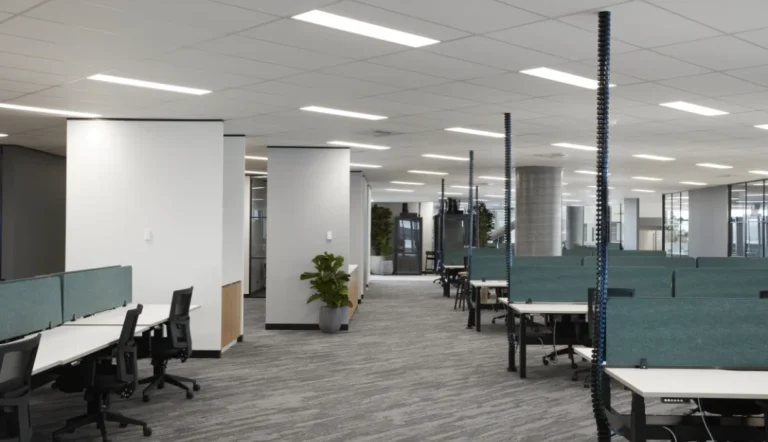
Why have workstation desks evolved over time? To put it simply, modern offices just can’t stand still. Businesses in Melbourne and around Australia are shifting away from rigid, “set-and-forget” floor plans and towards workspaces that can shift, grow, or shrink as teams change and develop. Modular workstations desks provide this functionality and more. Because each workstation section interlocks, clicks apart and reconfigures effortlessly, teams can scale up or down without incurring the cost or disruption of a full office redesign.
Scalability is also becoming a core consideration for workspaces across Melbourne, as companies grapple with fluctuating headcounts, hybrid schedules and agile project-based work. Modular workstations desks can help businesses scale or streamline their floor plan in real time, creating collaboration zones one week and quiet focus spaces the next. It’s a highly future-proof approach that recognises the messy, dynamic reality of hybrid work.
What Makes a Workstation “Modular”?
It’s the opposite of a fixed workstation. Modular systems were created to accommodate teams who work together but whose workstations need to adapt, reconfigure, expand, contract and change over time to suit. Everything in a modular office is interchangeable and flexible. It’s a system where the pieces are created to work with each other and all of it is designed to be changed when your teams need it to be.
Key Features
Modularity centres on the freedom to reconfigure. It’s important to be able to create new spaces and dynamic team layouts on demand as workgroups change and evolve over time. The workspace system has to be fluid, it needs to be able to expand and contract and re-form. You can start with a simple two-person pod and add to it later as the team grows. These can be extended further to become clusters, runs or larger collaborative zones.
Components should be height-adjustable, and clip, link or lock together. This makes changing the entire office layout a matter of minutes, not weeks. A modular system should be low-impact, with little noise, mess or disruption when it needs to be adjusted. If the business expands, you can seamlessly plug new team members into the existing space by attaching more desks or accessories. If a team shrinks, it’s equally easy to unplug the extra capacity.
Likewise, if a bank of desks is needed to be split into two focus areas with solid partitions to reduce noise and distractions, or joined together to create a single shared project space, the whole system can be easily reconfigured to suit.
Materials, Cable Management and Tech Integration
Cable management is a big part of any modular system. Every element in the office is supposed to plug together seamlessly, but it’s the worst part of an open-plan workspace. Modern modular workstations are built with materials that support ergonomics and user comfort, of course, but they are also selected for the ease of integrated cabling and tech.
That’s where the Executive Power Box was developed — a system-integrated power hub for use with modular workstations that contains cords, power points, adaptors and the like inside a sleek enclosure, while keeping the workstation looking open and free of cables. It means workstations look streamlined and the team has at-a-glance access to power when they need it. There are no trailing cables or messy power points or crowded charging stations.
Ergonomics and User Comfort
The key with a modular workstation system is that it’s not just the layout and the furniture that is reconfigurable, it’s also the user interface that is built into it. A growing number of systems allow their pods and workstations to have add-ons like privacy screens or partitions that can be attached in seconds.
A user could decide they want an enclosed space for concentrated solo work or a call and keep their partition in place. When they are ready to work or talk to “a neighbour”, the partition can come apart to create an open, flexible workspace. This level of user-led control makes the office feel more responsive and more human. It also works with the many ways different people like to work at different times of the day.
Types of Modular Workstations Melbourne Workplaces Use
Before you decide on the setup that is best for your team, it is always useful to first identify the types of workstation styles Melbourne businesses are using these days. Each workstation style has its own benefits and when optimised and arranged, they would make the most of the features of a space according to the need of a particular workplace.
While there are many possible workstation designs and combinations, the following options are the most practical modular workstations and their applicable situations.
Linear Benching Systems for Growing Teams
Linear benching is often the best choice for businesses that are either growing rapidly or moving their teams around regularly. The extended rows or corner styles of this workstation allow people to be added or removed without the need to redesign the office space.
Melbourne businesses that make use of linear benching are popular because it allows a team to be visually connected, encourages quick-moving work, and optimises smaller and open-plan office spaces. The entire system can also be considered a “plug-and-play” as it easily enables you to move around teams or people.
Pod-Based Workstations for Collaboration
Office pods, which are also workstation systems in a way, can be useful in workplaces where smaller teams need to get together to work as a group.
When optimised in the office space, this setup can allow for teams to collaborate more naturally and frequently than scheduled or formal meetings. It is a great solution for creative or project-based or cross-functional work as it gives your staff members a shared space yet enough personal space to focus.
Height-Adjustable Modular Setups
Height-adjustable workstations have grown popular these days as it allows employees the choice to sit and stand throughout the day. This not only helps with their movement but also increases concentration and decreases fatigue. When paired with the modular concept, this setup can be the answer for companies looking for a future-proof option to optimise workstations for comfort and space as well as increased productivity.
Acoustic Workstation Solutions for Focused Tasks
If you and your team need some serious concentration at the workplace, acoustic solutions might just be what you need. An acoustic modular workstation utilises sound-dampening materials, partitions, and some thoughtful angles to lower noise, create some sense of privacy and provide employees with the illusion of a personal space.
Finance teams, HR, legal and businesses in a similar field will love this. But because it is still based on a modular system, your layout and panels can be moved and changed to adapt to growing teams or a changing role.
The Benefits of Modular Workstations for Melbourne Offices
Modular workstations are one of the best solutions for Melbourne businesses to make the most of their space. Whether the business is operating from a small CBD space or a large suburban office, modular workstation systems allow for flexibility to move, expand or contract as needed without incurring significant fit-out expenses. This allows for business owners to have the freedom to expand at their own desired pace, as opposed to committing to set layouts.
The advantages of modularity becomes even more apparent for businesses shifting to an open plan office, where flexibility is paramount and furniture layouts need to be adaptable to new roles, project teams, and hybrid working patterns. The result of incorporating modular furniture into an office space is improved productivity and comfort for employees. When working in a modular workstations, workers have access to a workspace that feels custom-made for their needs, with less clutter and more ergonomic support, making it easier to shift between focused work and collaboration.
Not only does modularity offer business owners financial benefits, it also has a positive impact on the environment. Modular workstations have a longer life cycle, reducing landfill waste by being adaptable and reconfigurable as opposed to replaced. Modular furniture also represents a more sustainable approach to office design, a factor which is becoming increasingly considered as part of procurement processes across Melbourne.
How to Choose the Right Modular Workstations in Melbourne
Selecting a workstation system first requires a close assessment of how the business functions on a day-to-day basis. In many Melbourne based offices, there may be many different roles and staff members utilising the space. For example, groups that are more creative in their work and have collaborative workspaces may consider benching solutions.
On the other hand, a business that has analyst teams or client facing staff may prefer semi-private or private pods to improve focus. However, before selecting a specific workstation system, it is important to be honest with yourself in terms of your business’ working patterns, meeting cadences, and headcount trajectories. For example, if you are already thinking, “will your business be hot desking?” that in itself is a good indication that you need flexible workstations that can be easily shared, sanitised, and reconfigured without negatively affecting productivity.
Next, consider your foundational tech infrastructure needs. Workstations of today go beyond just providing surface space for work to be done. Power and data access are crucial to the modern workforce to avoid tripping over cables or constantly using extension cords. Consider where your screens, docking stations, or other peripherals will sit and where power will be accessed from. This could be from central power boxes, integrated cables or under desk data rails. The type of system chosen should take into account the long term IT infrastructure needs to avoid costly and disruptive retrofits down the line.
If you have plans to grow headcount or change your operations significantly, this should also be considered in terms of your work layout and how you can maximise the workstations. Modular systems have the advantage of allowing for significant reconfiguration, whether it be in headcount (increase or decrease), business units (expansion of departments), or physical layouts (add panels or remove partitions or dividers) without having to replace the entire system. If your business has seasonal headcount fluctuations or has plans for expansion, this is a key consideration to ensure the system you select is flexible.
Finally, know when a custom modular workstation system is the best route to go. If you have specific layout requirements, brand requirements, or specialised use cases, a custom system may offer the best long term value. The goal is to ensure every square metre of space is being used to its potential and that the furniture works for, rather than against, your team.
Common Layout Options Using Modular Workstations
Offices today require layouts that can easily scale to accommodate different team sizes, work styles, and hybrid work schedules. In addition to the many flexible design opportunities afforded by modular workstations, Melbourne-based businesses can test out new ways of working that define how people collaborate, concentrate and circulate in the office.
Selecting the right layout not only boosts productivity and enhances hybrid work but also allows businesses to maximise the use of their space.
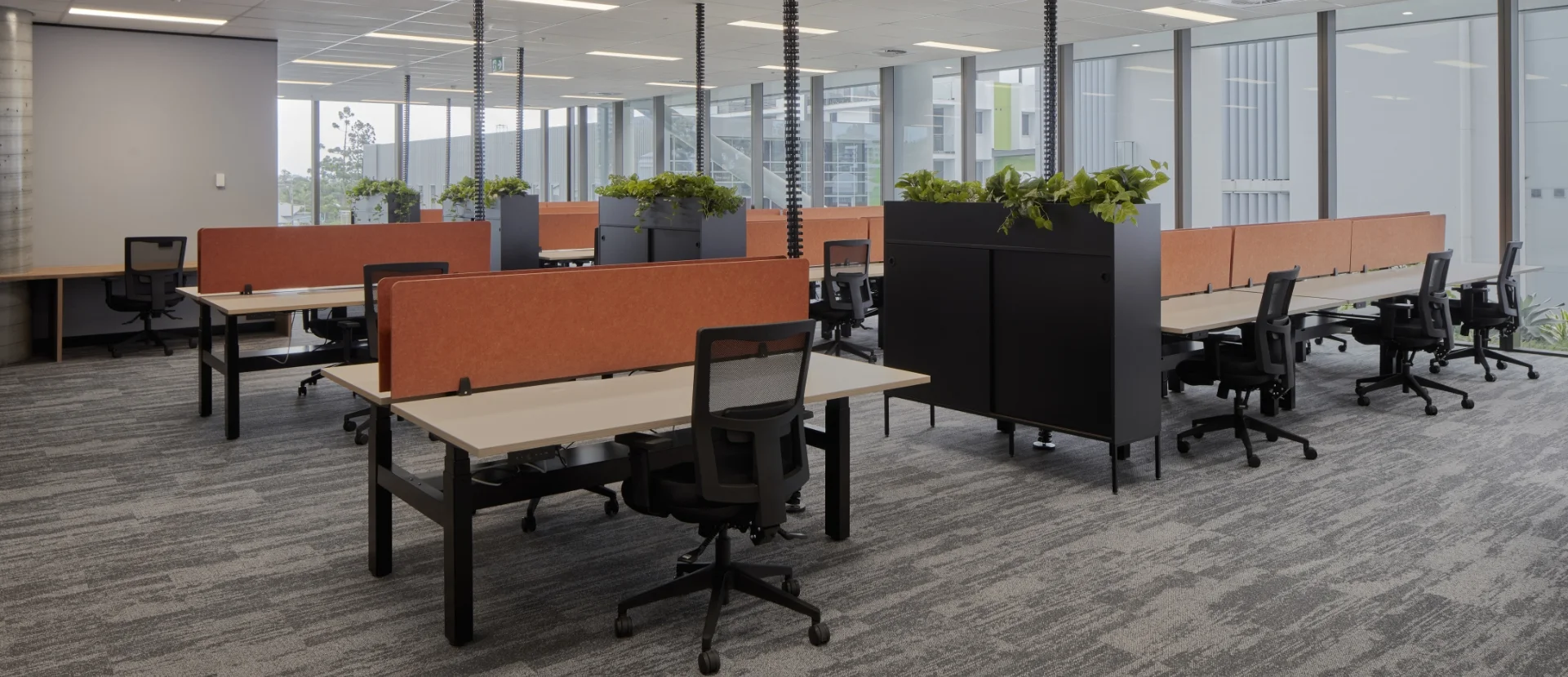
Open-Plan Configurations
Open-plan layouts continue to be popular among businesses who want to encourage communication and create a larger, more open office space. Modular desks can be easily reconfigured for expansion or contraction, offering management flexibility to adjust to team growth without a costly, permanent renovation. Open-plan layouts work well with businesses that value transparency and open flow.
Semi-Enclosed Work Zones
Semi-enclosed work zones are a great fit for teams who value collaboration as well as quiet concentration. This setup offers partial visual and acoustic separation to break up the open floor plan and minimise distractions while still connecting employees to the larger office space. Modifying the layout for growing or changing teams is as simple as repositioning, adding, or removing partition screens, making this a smart choice for offices that need flexible zoning.

Team-Based Clusters or Pods
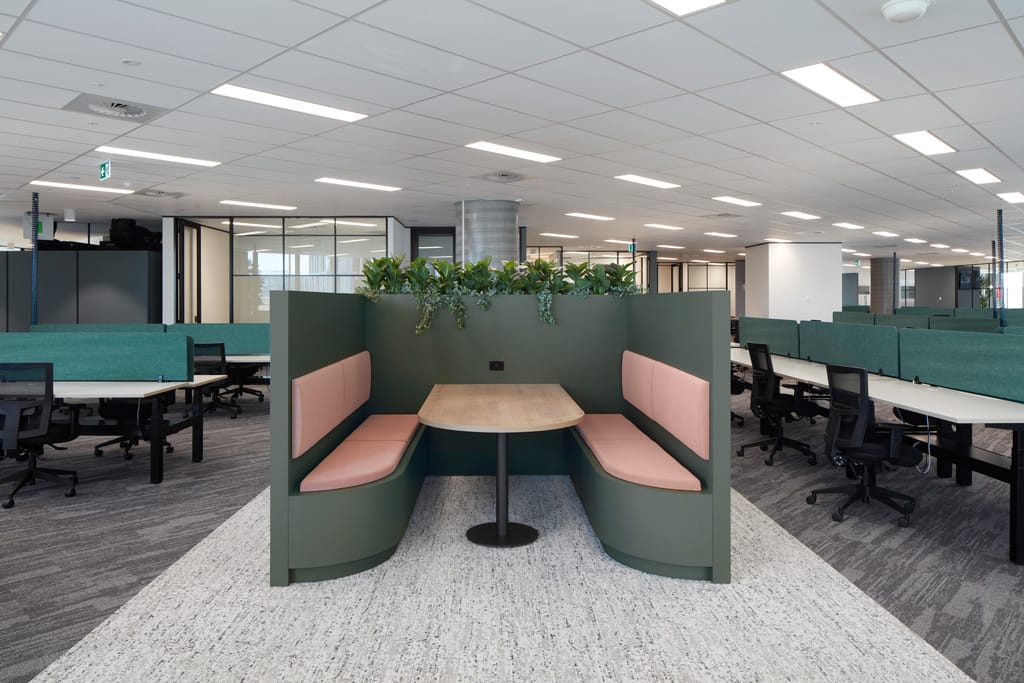
Team or project-based clusters, sometimes called pods, are ideal for supporting collaboration and ensuring that project teams are located together. Collaboration room furniture can be used to create distinct groupings within the larger floor plan. From partition height to desk orientation, these layouts are easy to reconfigure for new projects or priorities while maintaining a strong sense of team identity.
Blended Layouts for Hybrid Offices
Flexible workstations also offer a range of layout options to suit the unique needs of hybrid offices that must support staff as they alternate between remote and in-person work. Modular workstations can be paired with quiet zones, hot desks and casual meeting areas to create a coworking-style hub within a business’s office, with workspaces designed to reflect employees’ day-to-day tasks. From collaboration and connection to quiet concentration or digital communications with remote staff, a blended layout can be configured to support all staff with their in-office work.
When Workstations Need to be Reconfigured or Upgraded
As your team grows and develops, the way in which they work in their space naturally evolves. This is often when you first notice signs that your workstation layout isn’t quite as efficient as it could be. Collaboration feels stifled. People are occupying random spaces throughout the office just to find quiet. The flow of the office floor no longer corresponds with how your teams work each day. These micro points of friction can be some of the first clues that it’s time for a new configuration.
Workstation layouts are reconfigured in many modern businesses every few years, not because they are out of style or the furniture needs replacing, but because the way they work has changed. Growth, hybrid schedules, the introduction of new teams, new technology. These all have an impact on how office space needs to be organised. The great thing about modular systems is that it doesn’t need to be an overhaul that disrupts the whole office. Components can be moved, resized, reconfigured or even combined with new elements to better suit the office’s needs. Which of course helps keep the process and associated budget much lower.
Modularity is also a key factor when it comes to containing the costs associated with office fitouts. By opting for a workstation system that is adaptable and flexible, you’re avoiding the need to commit to a layout that will likely date within a few years. And instead of having to replace things, you can simply adapt, which makes growth transitions far easier, and keeps your workspace more in line with the way your people work (long after move-in day).
How Topaz Furniture Can Help
Modular workstations are part of our process at Topaz Furniture, as much as they are one of our solutions. When we design a workspace, we focus on how you work, how your space flows, and how your business needs to function today and tomorrow. With workstations from Topaz, whether your business is scaling, reshuffling teams, or rethinking your entire office, our modular workstation systems are purpose-built to suit Melbourne workplaces that need flexible solutions, durable products, and clean, functional design.
Topaz differentiates through our Design Hub, an integrated collaborative space that houses our design specialists. This is where your project comes to life with one of our experts as we work closely with your team(builder, architect, designer, project manager, or leadership team) to unpack the brief and ensure you feel confident moving through each stage of the design journey. Everything from workstation selection, space planning, colour palettes, and finishes to power integration and IT requirements are covered at the Design Hub to ensure nothing is left to chance.
Our clients love working with Topaz because it’s simple. You’re not choosing furniture, you’re working with a team that understands how Melbourne businesses work, how quickly they can change, and how to design a workstation layout that accommodates these fluctuations. Purpose-built modular workstation systems, hands-on design support, and a process built on clear communication and transparency allow Topaz to deliver workspaces that look great, function beautifully, and scale with you.
Building a Future-Ready Workspace with Modular Workstations
Planning an office redesign soon? It’s worth investing the time to consider workstations that grow with your team rather than get in the way. Modular workstations make it easier to adapt and rearrange your layout as teams change, technology upgrades, and the needs of the business shift over time, without compromising on cohesion, efficiency, or great design.
Contact us now to book a consultation or quote, or email hello@topazfurniture.com.au. Let’s build a workplace that’s fit for the future together.
More Related Articles

Author: Topaz Furniture

